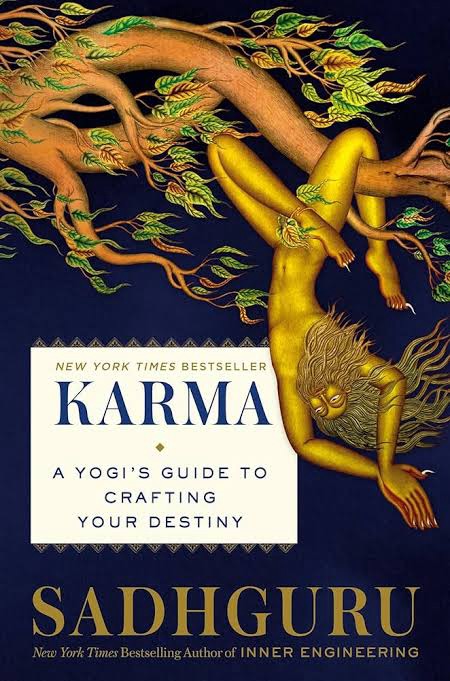
This book was gifted to me by a good friend of mine in Adana, Turkey, who is a devout follower of Sadhguru’s teachings.
Sadghuru divides his book into 3 parts, 1) On what is Karma 2) How to be aware of Karma and be on the drivers seat, 3) Queations about karma.
Below are some noteworthy excerpts from the book with my corresponding notes underneeth each quotation.
Part 1:
“… Depending on the type of physical, mental, and energetic actions you perform, you write your software. Once that software is written, your whole system functions accordingly. Based on the information from the past, certain memory patterns keep recurring. Now your life turns habitual, repetitive, and cyclical.
Over time, you become ensnared by your patterns. Like so many people, you probably don’t know why certain situations keep recurring in your inner and outer life. This is because these patterns are unconscious. As time goes on, you turn into a puppet of your accumulated past. …”
The power of habit as karma. Thoughts and actions turn into patterns, which becomes our karma.
“… You may talk freedom, but you are gold-plating your limitations all the time in absolute unawareness. Even as you extol the values of independence, everything about you—not just the way you look or feel or think, but even the way you sit or stand or walk— is determined by your past patterns. …”
Karma is a programmable inner engineering aspect of each individual which feeds off of repetitive patterns. It must be our goal to identify the possibly detrimental patterns as early as possible, and gradually work on step by step eliminating and replacing them with other positive ones.
“… However, it does not matter what volumes of karma you have, the moment you start stepping into the subtler dimensions of the etheric and bliss bodies, your karma cannot touch you. The law of cause and effect can operate only on the physical, mental, and energy levels. Beyond that, it has no impact. The moment you begin to taste the divine, as it were, your karma has no hold over you. …”
The power of yogic meditations in order to pause the influence of karmic influences on our physical, mental and energy levels and experience a sense of bliss serenity.
“… If you exude another type of vasana, existence will make sure you land up in certain other places. So what moves toward you and also what moves away from you are determined by the smell that emanates from you. Your vasana depends, of course, entirely on the kind of residual memory or karmic content you carry. …”
Sadhguru mentions here that the vasana ‘smell’ that our karma emits attracts possible coincidences in our life. Therefore our inner engineering is what determines the external life occurrences that may seem to happen by luck.
“… A negative thought, as we know, can breed karma. A negative thought combined with a negative emotion means a deeper karma. When a negative thought, negative emotion, and negative external action combine, there is even deeper karma. When a negative thought and negative emotion combine with a recurrent mental action, that karma is deeper still. …”
Levels of intensity in Karma based on its combination with emotions and actions. Your thoughts are the source of what makes your character. Thoughts must be carefully monitored, and negative ones weeded out, for negative thinking has absolutely no benefit to anyone or anything.
“… Generally, the word karma is used in a rudimentary way to suggest that you did something bad and so bad things will happen to you. This is a very limited and simplistic way of looking at life. Karma has nothing to do with moralistic categories of good and bad; it is related only to cause and effect. …”
The karma we build is based on how we perceive and react to what happens.
“… If you go to a movie as a viewer, you may enjoy the entertainment-you may laugh, cry, eat your popcorn, and come out. But filmmakers view the whole drama differently. They know how the film is made; they know the craft behind it. A mere moviegoer will never understand how the film was created. The same is true of life. There were ancient wisdom traditions that understood how life worked, and certain practices that might seem strange to us today emerged from that perception. …”
This is a great analogy that I also interpret as the importance of studying theological writings. Even from the point of an atheist, religion could be seen as writings of wisdom.
“… The time has come to wake up to the fact that there is only one crime against life: to make believe that you are something other than life. Unfortunately, our idea of individuality is separateness, and that is the basis of all suffering. …”
Individualism and exclusiveness instead of inclusiveness is what breeds constraining karma in us. We must be able to identify and be one with mother nature as opposed to seeing everything as a resource to be harvested for our own gain.
“… When involvement is selective, you fall into the trap of entanglement. Here is the central problem: Selective involvement leads to suffering and karma; detachment leads to lifelessness. …”
When we approach every day life with nothing but our memories with all its karmic weight in mind, we are trapped in the never ending cycle of building actionable karma which is detrimental to our spiritual well being. It is best to be in a meditative state of mind where past memories aren’t dominating our actions, where we are more open to all and more detached from forming exclusive connections with people, which may also build future karma, things like jealousy and other passions. The end goal in a way, is to curb the possibility of compulsions finding its sources from negative emotions.
“… The goal for every freedom seeker is the same: to attend to your karma now rather than wait for life to throw it at you. …”
To no delay in dealing with our karmic energies within.
“… In an age of artificial intelligence, only those who are capable of exercising intelligence beyond memory will have something truly valuable to contribute. The fundamental difference between a human being and a machine is perception. Perception is something a machine will never possess. The machine will be capable of data accumulation, analysis, and action (all of which are functions of the intellect), but little else. …”
Superiority in analytical and memory based intelligence is not enough to outshine the human being with its many faceted attributes, perception and emotional thinking being some of them, which artificial intelligence would never be able to replace.
Part 2:
“… The logic of karma yoga is simple. Every single activity you engage in can be used as a process of entanglement or as a process of liberation. If your activity is used as a process of entanglement, it is karma. If you use the same activity as a process of liberation, it is karma yoga. …”
Using every activity to reprogram our karma and get back to our child like pure mental state of wonder.
“… If action creates bondage, it is karma. If action creates freedom, it is karma yoga. If you perform action miserably, it is karma. If you perform action joyfully and effortlessly, it is karma yoga. …”
Merely executing actions just to serve our good will is not an action of karma yoga, but the mindset involved in our action is what makes it a step toward our mental freedom instead of entanglement. What is on our mind while we help an elderly man or forgive a wrong doer from the past? Is it the growing ledger of our good deeds or an inclusive mental state that cares of everyone as a brother or sister without special treatment.
“… The basis of karma yoga is to be involved in the process, not the product. Whether you approach your karma through awareness or abandon, the point is to immerse oneself in the journey and not be anxious about the destination. …”
Precisely why I was always interested in the composition building part of music rather than performance. Unknowingly, I had been in this meditative abandon state devoid of my past karmic weight, which had drawn me to the activity of composing music. Yoga, according to Sadhguru is a way to sustain this feeling for longer durations.
“… Our current education has the effect of creating endless greed, unbridled want. Those who act without expectation of reward would be considered losers in the society we have created for ourselves. Our idea of progress is to want to be like someone else, or else to compete, to outdo others. This madness is the curse of our modern world. …”
Hyper materialism seems to be the utmost priority in the new generations of this world globally. Sadly, everything goes in the name of making a profit. For the vast majority, the world is simply there for the taking and harvesting, a finite but amble source to take from. This thinking must end.
“… The old songs and poems of the East, from the ancient love lyrics to pop songs in cinema, extolled lifetimes- janam janam (life after life)—of togetherness, not merely for romantic reasons. Continuity and stability were valorized because they ensured a firm and reliable basis to your life from which you could aspire to the ultimate. Marriage was not just about two people’s little romance and their little families. It was about two people coming together for their ultimate liberation. This is why so many traditions view marriage as a sacrament. In traditional Hindu ritual, the mantras chanted while the couple circles the sacred fire is about consecrating the relationship and energy of two people so that they can both grow together to their ultimate possibility. …”
Nowadays, the way modern culture transformed marriage is so shallow and primarily materialistically driven devoid of any religious bondage, almost like a business deal, which is of-course significantly rigged. The spiritual aspect of marriage seems to be never discussed or mentioned. Beauty and material status seem to be the modern day determinants of the match making processes which leads to marriage, as opposed to spiritual characteristics and past karmic loads.
“…Happiness is just your constant state of existence. …”
Obsessing with the future and past is what activates our karmic load, leaving us in despair or fleeting joy. A state of happiness, devoid of anxiety or depression is our natural norm. The challenge is to keep it this way, or be able to turn off the obsessing mind and focus on the moment, the now.
“… Whenever pain enters your life, you tend to wonder, Why me? Even my mother-in-law didn’t get it! Of all the people in the world, why me?
But once you accept something, it becomes a part of you. Even for a moment, if you accept something as a part of you, you attain a profound sense of harmony. …”
In the past I have noticed that the more I travelled the more bitter I have become, due to all the comparisons I constructed in my mind between by home country and the other counties I have visited. Why couldn’t Adana be like this or that similar to Florence or Stuttgart etc. The key is acceptance.
Part 3;
“… We get the society we deserve. So don’t think of it as her karma. Think of it as your own. Inaction is also karma. …”
If our society is getting culturally sick it is our responsibility to work on amending it, or at least contribute to fixing it in what ever scale possible. Sitting back and pretending to have no power over conspiring events around us also creates bad karma. If it is in our power to contribute to the well being of a society we must do so. Avoidance and inaction does not make us immune to future catastrophic events which may transpire in our neighborhood.
“… Life cannot be owned. The need to own life is responsible for much suffering on this planet. Let’s say you meet someone and say “I love you.” It feels really nice for three days. Then you think you must capture this love. Well, you ended up with a marriage!
Nothing wrong with that. But the beauty of an experience cannot be captured; it cannot be institutionalized. This is the fundamental reason karma has become a problem. It is because you’re trying to capture life. You cannot own life; you can only live it. …”
We are all guests in this world.
“… So this empty space within you is like a bubble. Karma is the wall of the bubble. …”
Our past experiences (accumulated karma) is a part of what forms our exclusive character (the bubble layer which separates the inner air from the outside air), what separates us from the outside world. This bubble layer ought not thicken too much. However, we need some of it to preserve our character. Balance is key.
“… eliminating a single question from your life: What about me? …”
The root cause of all problems in society and the creator of karma, selfishness.
“… But those who long to leave a footprint shall never fly. …”
As an artist/architect, ofcourse endeavoring to leave a footprint through our work often comes to mind, and is seen as a useful tool in motivation. Once again, it is important to note here that balance is key, and the ego must be tamed and be put under control through mental practices.
 Şahin Kaya Arıkoğlu