Imagination is not separate from reality; rather, it is an integral part of it—a private reality that is intricately woven into the fabric of existence. Much like a laboratory, where experiments are conducted to uncover truths about the physical world, imagination is where we test and refine ideas, crafting them before they manifest in the external world. The thin bone barrier of the skull is all that separates this mental laboratory from our broader reality. And yet, what transpires within this private space frequently influences our external world, just as external experiences shape our imagination in return. Therefore, the degree of mastery we exhibit in navigating the physical world is intrinsically tied to our ability to command and cultivate our inner faculties—the private realm of thought and reflection.*
Consider the concept of black holes: their existence was not initially confirmed through the lens of a telescope but was instead conceived through the power of human imagination and the rigor of mathematical reasoning. The idea of a black hole emerged from the search for elegance and beauty within the mathematical equations of Einstein’s theory of general relativity. These celestial objects, with singularities at their core and event horizons at their external boundaries, remained purely theoretical until empirical evidence confirmed their reality. The inception of the concept took place in the imagination and its manifestation in space was later proven as technologies advanced. Similarly, Einstein’s theories of special and general relativity originated from intricate thought experiments long before their validation in the physical world.1 These examples underscore how imagination, especially when guided by reason and creativity, is a cornerstone of human progress and must therefore be recognized and nurtured as such in our largely obsolete educational systems.
“… this incredible fact that a discovery motivated by a search after the beautiful in mathematics should find its exact replica in Nature, persuades me to say that beauty is that to which the human mind responds at its deepest and most profound… “2
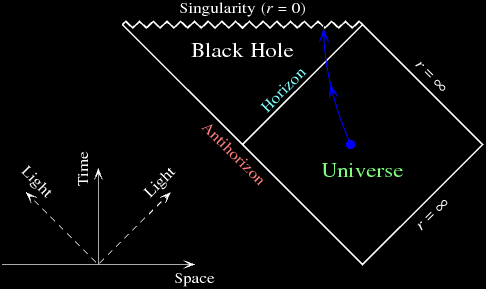
Scientists and astrophysicists are currently deeply engaged in exploring the imaginative capacities of their minds to unravel the mysteries of black holes. The singularity at the center of a black hole remains one of the most enigmatic phenomena in modern physics, with theories and hypotheses continuously being developed. One such theory, formulated by Roger Penrose, is represented in the diagram below. The Penrose diagram seeks to conceptualize the fabric of space-time in relation to a black hole. It addresses key questions: What occurs when an object crosses the event horizon? What lies within the horizon, where not even light can escape from, and which we are unable to observe through with the current technologies? At present, much of our understanding relies on the power of human imagination, and it is via this intellectual faculty that we may uncover a solution to the black hole puzzle in the near future.3

 Şahin Kaya Arıkoğlu