Imagination is not separate from reality; rather, it is an integral part of it—a private reality that is intricately woven into the fabric of existence. Much like a laboratory, where experiments are conducted to uncover truths about the physical world, imagination is where we test and refine ideas, crafting them before they manifest in the external world. The thin bone barrier of the skull is all that separates this mental laboratory from our broader reality. And yet, what transpires within this private space frequently influences our external world, just as external experiences shape our imagination in return. Therefore, the degree of mastery we exhibit in navigating the physical world is intrinsically tied to our ability to command and cultivate our inner faculties—the private realm of thought and reflection.*
Consider the concept of black holes: their existence was not initially confirmed through the lens of a telescope but was instead conceived through the power of human imagination and the rigor of mathematical reasoning. The idea of a black hole emerged from the search for elegance and beauty within the mathematical equations of Einstein’s theory of general relativity. These celestial objects, with singularities at their core and event horizons at their external boundaries, remained purely theoretical until empirical evidence confirmed their reality. The inception of the concept took place in the imagination and its manifestation in space was later proven as technologies advanced. Similarly, Einstein’s theories of special and general relativity originated from intricate thought experiments long before their validation in the physical world.1 These examples underscore how imagination, especially when guided by reason and creativity, is a cornerstone of human progress and must therefore be recognized and nurtured as such in our largely obsolete educational systems.
“… this incredible fact that a discovery motivated by a search after the beautiful in mathematics should find its exact replica in Nature, persuades me to say that beauty is that to which the human mind responds at its deepest and most profound… “2
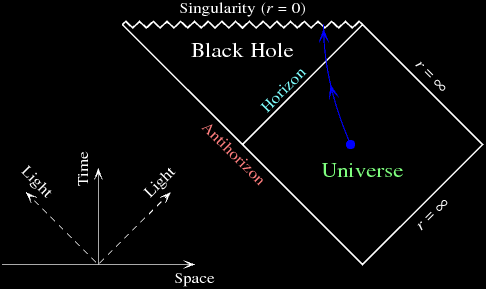
Scientists and astrophysicists are currently deeply engaged in exploring the imaginative capacities of their minds to unravel the mysteries of black holes. The singularity at the center of a black hole remains one of the most enigmatic phenomena in modern physics, with theories and hypotheses continuously being developed. One such theory, formulated by Roger Penrose, is represented in the diagram below. The Penrose diagram seeks to conceptualize the fabric of space-time in relation to a black hole. It addresses key questions: What occurs when an object crosses the event horizon? What lies within the horizon, where not even light can escape from, and which we are unable to observe through with the current technologies? At present, much of our understanding relies on the power of human imagination, and it is via this intellectual faculty that we may uncover a solution to the black hole puzzle in the near future.3
Imagination and consciousness is a pinnacle of humanity, an ability that elevates to envision and create. It enables us to imagine alternative worlds and scenarios, down to the most minute details, shaping possibilities that transcend our immediate reality. This realization became even more apparent to me as I began reading Leo Tolstoy’s book, War and Peace. After reading through the first few pages, I approached the novel with skepticism, assuming it to be a lengthy book highlighting a banal story, which I had no interest in further reading. However, as I stubbornly forced myself to delve deeper into the book, I was gradually struck by Tolstoy’s imaginative brilliance. His ability to breathe life into his characters—imbuing them with emotional depth, vividly described facial expressions, and with his intricate personal stories—creates a tapestry of human experience that is evocative and feels larger than life. What impressed me most was not just the lessons of humanity embedded within the novel but the well detailed architecture of the visual and tactile imagination of Tolstoy. His intricate details, his orchestration of overlapping stories, and his portrayal of human nature transcends fiction. His work is a testament to the power of imagination to mirror and enhance reality, to capture the complexities of life in ways that resonate across generations.4
Whether in science, as seen in the discovery of black holes, or in art and literature, as exemplified by Tolstoy’s masterful storytelling, imagination is humanity’s most profound tool for understanding and transforming the world. It allows us to envision what is not yet real, to push the boundaries of what is possible, and to connect deeply with one another. It is, in essence, the laboratory where reality is born.
Dreams can also be referred to as an integral aspect of imagination, occurring when the body is at rest, and consciousness is largely inactive. During this state, the mind taps into its full imaginative potential, generating narratives, scenarios, visuals, concepts, and even intricate architectural or urban design ideas.‡ In dreams, we can observe the vast, limitless scope of our creative faculties. However, one limitation of dreams is their ephemeral nature in our memories and our inability to take note of them. Dreams often fade rapidly from our minds. The most vivid and intense dreams typically occur during the REM (Rapid Eye Movement) phase of sleep and one needs to fulfill these sleep hours in order to sustain a healthy and balanced life.5 I am keenly aware of the potency of dreams and the significant role our subconscious mind within them. I hope that, in the future, we may develop methods to strategically harness our dreams, channeling them to enhance and support our creative and professional endeavors.
* “The soul becomes dyed with the color of its thoughts.” – Emperor Marcus Aurelius (Meditations, Book 5, Chapter 16)
† This diagram, known as the Penrose diagram, illustrates the scenario in which an astronaut crosses the event horizon of a black hole. In the graph, time is represented on the vertical axis, while space is shown along the horizontal axis. The speed of light is depicted by diagonal lines, which indicate the maximum possible velocity, with no object capable of exceeding the angle of these lines. The blue line in the diagram represents the astronaut’s world line, demonstrating how the astronaut falls past the event horizon and moves inexorably toward the singularity at the center of the black hole. Within the black hole, the roles of space and time become inverted, making the journey toward singularity inevitable. Once past the event horizon, escape from the black hole is impossible.
‡ This, of course, is something that I experience mainly, because of my architectural background. I am unable to express my sorrow at my inability to note down the fantastic design ideas I have dreamt of and then forgotten. Such fleeting treasures in the mind.
Footnotes:
- Einstein’s theory of general relativity, which posited that space is bent around large masses, was confirmed during a solar eclipse on May 29, 1919. English astronomer Arthur Eddington and his team conducted observations from two locations: one in Principe Island off the west coast of Africa and the other in Sobral, Brazil, where they measured the bending of starlight as it passed near the Sun, validating Einstein’s prediction.
- Subrahmanyan Chandrasekhar, a renowned astrophysicist and Nobel laureate. He expressed this sentiment in his talk titled “Shakespeare, Newton, and Beethoven,” where he explored the interplay between art and science.
- For more information on Black holes, I recommend the book: Black Holes: The Key to Understanding the Universe, by Brian Cox and Jeffrey R. Forshaw
- War and Peace by Leo Tolstoy
- For more information on dreams and their effects on our health, please read: Outlive by Peter Attia
Image Credits:
- Penrose Diagram depicting a blackhole.
 Şahin Kaya Arıkoğlu