Diego Velázquez’s renditions of various figures in the Spanish court of Philip IV capture moments of melancholic wisdom,—an awareness of the inner working of the Spanish court at the time, due to their unrestricted access to all parts of it—yet these people were never taken seriously, perhaps due to their diminutive physical appearances. However, Velazques has painted them under a deeper light. Unfortunately, artists are often succumbed to tailoring their works to the preferences of their patrons, who are typically more interested in paintings that align with the prevailing trends of the time, leaving no chance to the artist for exploring his intellectual subconsciousness through paid commissions. As a result, thinkers—who often possess a profound intellectual and creative sensibility—can find themselves constrained by such demands, deeply yearning to break free and create something more authentic, something that truly reflects the deeper essence of their time and place, worthy of being eternalized. This is precisely what Velázquez achieved in his depictions of dwarves and buffoons in the Spanish court. He moved beyond mere representation, capturing the essence of these individuals and revealing the authentic depth of their beings.

In The Portrait of Francisco Lezcano (above), Velázquez captures a moment, depicting the dwarf in a state of anticipation and restlessness. He holds his cards tightly, his grip fervent yet uncertain, as he glances toward the court*, awaiting confirmation to begin his performance. His posture is particularly carefully crafted by the painter—one foot positioned upright—emphasizing his small stature while also conveying a sense of readiness with one foot on the ground. Velázquez masterfully highlights Lezcano’s distinctive form, rendering it with his almost childlike, innocent expression. There is a psychological depth to the portrayal—Lezcano seems not to be quite happy, yet there is a sense of resigned dedication to his role. His demeanor suggests the emotional weight of his position in court life, caught between his duty and personal sentiment, which most likely is a complex mix of disdain and enthusiasm. Additionally, the background deserves attention. The wintry mountains and serene landscape behind him form its own distinct world, while not distracting from the subject to its carefully devised color palate and pictorial composition.1
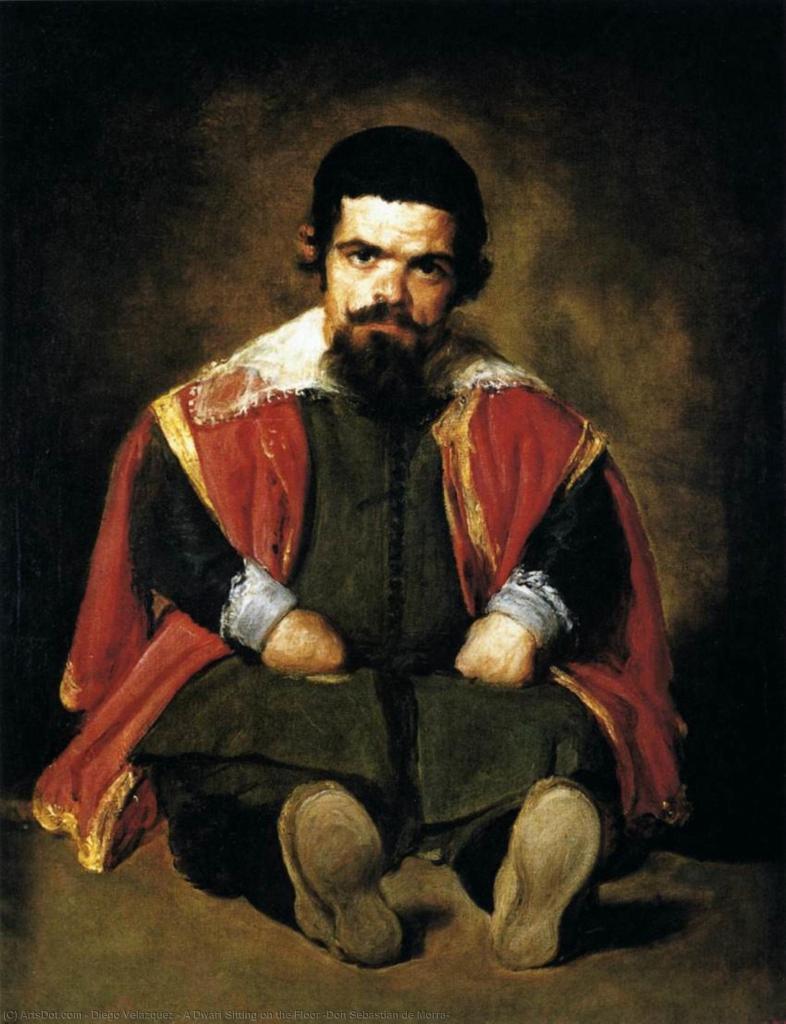
In the portrait of Sebastián de Morra above, the dwarf sits on the floor in an almost comical pose, his feet prominently displayed. Yet his face is deeply expressive, exuding an intelligence and introspection that sharply contrasts with his posture. This painting warrants particular attention for its masterful use of color and overall composition. The subject’s attire, rendered in a manner that is both regal and playful, evokes a sense of irony—an almost king-like costume meant in jest. Yet, in contrast to this theatrical outfit, his mustache and beard reflect the serious fashion of the time, while the weight of his facial expression conveys a deeper emotional presence. His posture—arms resting on his lap and heels prominently displayed—subtly emphasizes his small stature, reinforcing his identity as a dwarf. The floor and wall appear to blend seamlessly, creating a unified background plane that, despite its abstraction, is rendered with brushstrokes that suggest depth and perspective. This masterly approach allows the background to recede, serving its purpose without distraction, while its muted tones and subtle execution draw stark attention to the central figure. The significance of this work was recognized by later artists, including Salvador Dalí, who was so captivated by its composition and psychological depth that he reinterpreted it with a surrealist touch himself.2
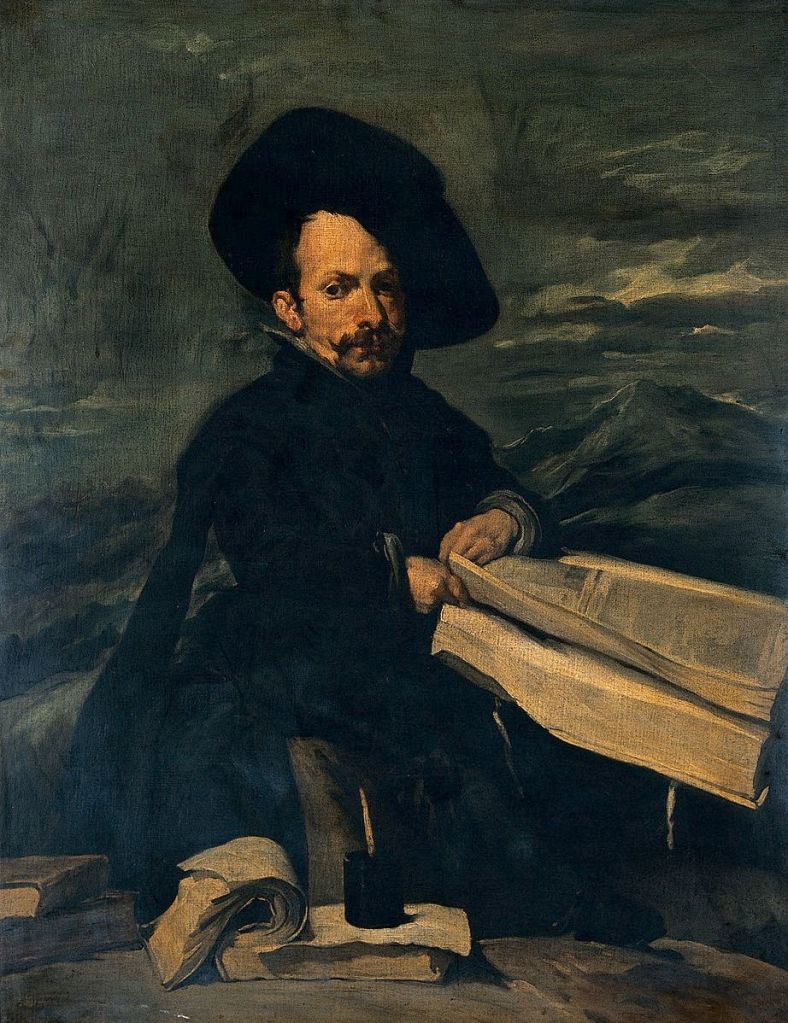
In the Portrait of Don Diego de Acedo, “El Primo” (1645), (above) the subject holds an important book in his lap, reinforcing an image of intellect and contemplation. Once again, Velázquez masterfully plays with contrast—the dwarf’s small stature against the weighty tome, the foreground against the background—all elements beautifully composed.
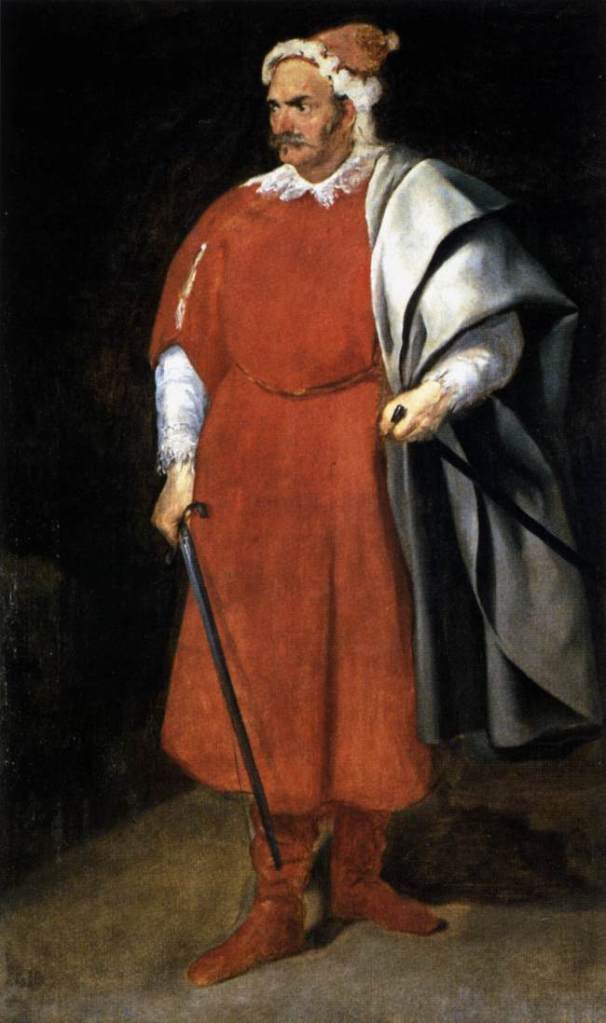
Another striking example is Portrait of Don Cristóbal de Castañeda y Pernia, “Barbarroja”. Clad in red, the buffoon clutches the scabbard of his sword with a strong grip, but at the same time holds the saber itself less firm on his right hand, as if exposing a mind teetering between feigned instability as a role and genuine instability. His serious expression, combined with the absurdity of his costume creates an air of mystery in his character. He is, in reality, merely a court jester, yet Velázquez imbues him with gravity and significance. The unsettling facial expression here is worthy of further artistic scrutiny.

Interestingly, when one examines Velázquez’s paintings of philosophers, such as Aesop, the famed Greek fabulist, a striking resemblance emerges between the expressions of these intellectuals and those of the dwarves and buffoons of the Spanish court. It is as if Velázquez sought to convey a deeper message about their lives behind the scenes—suggesting that wisdom, perception, and depth of character are not reserved for philosophers alone. Through his masterful brushwork, Velázquez elevates these marginalized figures, transforming them from mere entertainers into observers of the world around them who are yearning to bring forth their stories to a curious audience. In this regard, through his mastery, Velázquez transcends contemporary artistic trends, offering for the first time a uniquely impressionistic interpretation of his subjects.
* I am guessing here, what I mean is “most likely he is glancing at the Spanish Court in anticipation of a signal for his turn to entertain.
Image Credits:
Image 4:https://www.wga.hu/html_m/v/velazque/06/0606vela.html
Image 5: https://tr.wikipedia.org/wiki/Dosya:Diego_Velasquez,_Aesop.jpg
Footnoes:
- I would like to suggest Taschen’s book Velazquez written by Norbert Wolf for receiving a good introduction on the painters works with brief explanations on each presented painting ↩︎
- https://www.salvador-dali.org/en/artwork/catalogue-raisonne-paintings/obra/959/untitled-after-the-jester-don-sebastian-de-morra-by-velazquez-in-the-courtyard-of-el-escorial ↩︎
 Şahin Kaya Arıkoğlu


