Tag Archives: art

On The Necessary Steps for The Revival of Civic Art

A city reflects the collective mindset of its residents. Its structure and condition mirrors the internal values and priorities of the people who occupy it. Consequently, the quality and state of the general organization of its urban fabric—such as pedestrian walkways, bicycle lanes, parking configurations, and green spaces—mirror the collective consciousness of the populace.

It is tempting to attribute the disorganization and urban problems of a town solely to the executive leader in charge, such as the mayor or governor. While these figures play significant roles, in democratic systems, they are not permanent appointments; they are replaced or re-elected over time. Leaving their offices to new faces and, thus, new policies. Democracy, by definition, places the power in the hands of the people, meaning that those who are in charge and shape the cities—the executives and legislators—are themselves products of the citizenry. Cities, therefore, are reflections of the collective understandings, priorities, and values of the population.

Since civic art is a multigenerational art form that takes a long time to complete, even if a visionary and highly capable executive were to implement sweeping reforms to reorganize a city with remarkable foresight during his tenure, the continuity and completion of his efforts would ultimately depend on those who succeed him. And without a well-educated and civic-minded populace, the next nomination would go to a leader with no understanding and appreciation for his predecessor’s works; therefore, his work would be rendered incomplete, and the cycle of urban dysfunction would inevitably repeat itself.

Philip IV in Armour, c, 1628. Oil on canvas, Madrid, Museo del Prado. By Velazquez1

On a separate note: The British historian, Colin Rowe, advocated for urban harmony achieved through a collage-like integration of architectural elements from various historical periods. He believed that juxtaposing structures from eras such as monarchical times, ancient Rome, and modern democracies creates a richly layered urban fabric. This approach, detailed in his work “Collage City,” emphasizes the value of diverse historical contributions coexisting within the urban environment.2

Continue reading
On the Paradox of Failure

Today’s self-development philosophies often encourage us to emulate people who are successful on the surface: those who are achieving, advancing, and seemingly on the “right” path in life. The advice is simple: listen to the successful, and avoid taking counsel from those who have failed in their business ventures or faced financial ruin due to wrong choices. However, I disagree. In reality, some of the most profound wisdom is often derived from those who have faced failure or adversity for long durations. These individuals have had the opportunity to reflect on their setbacks, examining the underlying causes and potential solutions they would employ if given the chance to rewind time. On the other hand, successful individuals—particularly those with innate talent—often achieve success without engaging in deep reflection about their journey. Usually, people tend to analyze their past actions with more scrutiny when the outcome was unfavorable. When success comes easily, the reasons behind it can also be as easily overlooked. However, when success is the result of perseverance and hard work during times of apparent failure, one gains a clear understanding of the incremental steps that lead to achievement.

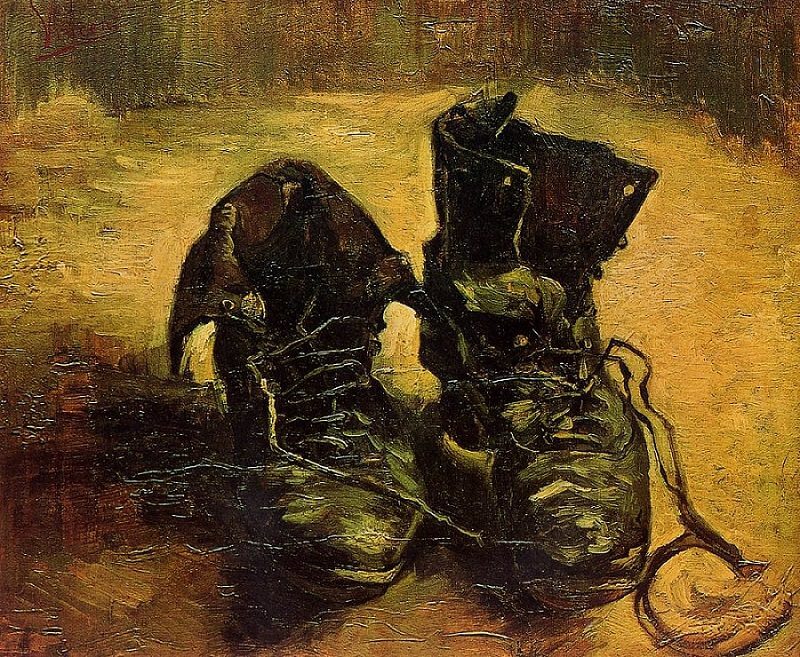
During Vincent van Gogh’s time, most artists were preoccupied with creating idyllic natural landscapes, characterized by cheerful and harmonious compositions. Van Gogh, however, driven perhaps in part by his complex psychological state, gravitated toward capturing a grittier, more visceral essence of nature—raw, unrefined, and often less commercially appealing, as exemplified in his painting below of a pair of shoes. Vincent’s work was largely unappreciated during his lifetime. His brother Theo, who tirelessly supported him, struggled to sell his paintings due to their unconventional style and melancholy. Within his family, Vincent was often regarded as a failure, a perception that weighed heavily on his mind and fueled his relentless quest for purpose and recognition. Today, his paintings are celebrated worldwide, not only for their groundbreaking technique and emotional depth but also for the profound impact on the trajectory of modern art. What was once deemed unmarketable now holds immense cultural and monetary value, a testament to the timeless resonance of Van Gogh’s vision.1

Image 1: A Pair of Shoes, 1886 by Vincent Van Gogh

Success, by its very nature, is built on the foundation of repeated failures. A person may fail once, twice, or even nine times before finally succeeding on their tenth attempt. But what if the individual we regard as a “failure” is currently on his ninth attempt? Should his insights acquired from the past 8 attempts be disregarded entirely? I argue not. These individuals, though marked by their missteps, may possess valuable perspectives that can inform our own journeys. This is precisely why I struggle to accept society (or the free market) as the ultimate authority in determining who deserves to be celebrated as successful and who is dismissed as a failure. Society, after all, once dismissed a struggling artist like Vincent van Gogh as a failure. Perhaps if Vincent had lived longer and not succumbed to despair, he might have achieved a breakthrough in his lifetime as well, creating a work so profound it would have swayed even the most skeptical art connoisseurs of his generation. Tragically, he simply ran out of time, leaving the remnants of his genius to be recognized only posthumously.

Van Gogh’s case underscores the importance of establishing a correct mindset and building a strong sense of self-worth and unwavering belief in one’s own talents. The path to greatness is rarely straightforward, and more often than not, it is fraught with doubt, resistance, and discouragement—even from those closest to us. It’s a peculiar mystery of life: why do we, as a society, so often discourage our peers from succeeding? Is it envy, fear of change, or simply an inability to recognize potential when it doesn’t conform to familiar norms? I don’t have the answers, but it’s a poignant reminder of the resilience required to pursue one’s vision in the face of widespread discouraging doubt.

Continue reading

A Case For The Revival of Pure Forms in Architecture

Abstract: Through the discoveries made in astrophysics, it is safe to postulate that cosmic forces (gravity) exerted on mass prioritize on the long term establishment of equilibrium and purity. Our solar system is currently in its long term equilibrium phase, where planetary orbit takes place around the Sun and life flourishes on Earth. In Architecture, long term structural durability and aesthetic superiority may be achieved by implementing solids and voids that are designed with purity in mind. The geometric methods we may use for this deserves an entire separate paper or book on its own. The Roman architect Marcus Vitruvius Pollio has written extensively on these topics. However, in this essay, we will focus on the general argument for architectural purity. In times when liberated organic models of form dominate the avant-garde, it is appropriate and timely to present this alternative point of view.

The premise above will be disambiguated through worldly analogies, scientific observations and thought experiments presented in this paper.

An artistic illustration of Einstein’s theory of General Relativity, depicting a curved/bent fabric located in the space-time continuum under the influence of gravitational forces emitted by a perfectly spherical mass, causing long term orbital motion and equilibrium around stars and planets.

Continue reading