Tag Archives: Philosophy

Exploring the Possibility of Telepathic Communication

“… The ether is a great cosmic mass of eternal forces of vibration. It is made up of both destructive vibrations and constructive vibrations. It carries, at all times, vibrations of fear, poverty, disease, failure, misery; and vibrations of prosperity, health, success, and happiness, just as surely as it carries the sound of hundreds of orchestrations of music, and hundreds of human voices, all of which maintain their own individuality, and means of identification, through the medium of radio. …”

Think and Grow Rich, Napoleon Hill pg.44

Guglielmo Marconi with an early version of his radio invention, photo taken around 1890

When first proposed the idea of transmitting messages through invisible radio waves, Guglielmo Marconi’s contemporaries dismissed him as delusional. Unable to imagine that voices and signals could travel through the air without wires, some even went so far as to place him under psychiatric supervision. Yet Marconi persevered, conducting experiments on rooftops and across open fields, gradually proving that his invention could span great distances. His breakthroughs not only revolutionized communication but also laid the groundwork for innovations that would reshape warfare, commerce, and everyday life. Today, radio communication is a cornerstone of modern life, from emergency services to global broadcasting, from navigation systems to the invisible networks that connect our smartphones1. The discovery and use of radio waves stands as a powerful reminder that what once seemed like fantasy can, through vision and persistence, become foundational technology—and that progress often begins at the edge of disbelief.

This paper’s premise: could telepathy—communication with others through the power of thought—be another frontier awaiting discovery? A mystery embedded within the ether, not transmitted through radio devices, but instead through our minds?

Continue reading
The Eye is The Lantern of The Soul

22 “The eye is the lamp of the body. If your eyes are healthy,[a] your whole body will be full of light. 23 But if your eyes are unhealthy,[b] your whole body will be full of darkness. If then the light within you is darkness, how great is that darkness!1

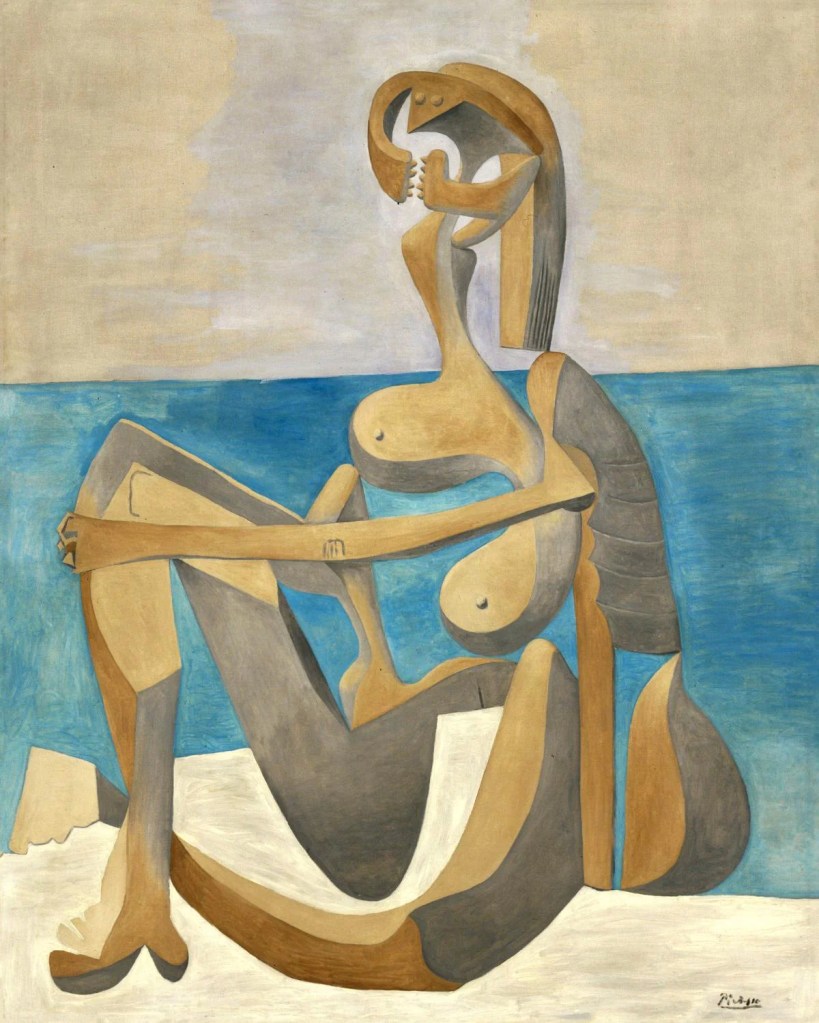
The eye, a window through which our inner selves connect with the external world. When we observe our surroundings—whether objects, nature, or other people—we are not merely analyzing or contemplating. We are also, perhaps unconsciously, projecting our inner state, our spiritual essence, onto the world (people) around us.

This projection is especially pronounced in social interactions. When someone is experiencing emotional turmoil or sadness, often times they ascribe their internal struggles to those around them. This tendency to fabricate a link with inner conflict can even result in the unjust attribution of one’s own misdeeds on to others. It becomes a coping mechanism for deflecting or processing the internal state, often to the detriment of those they project upon, in most cases, loved ones.


Image 1: Seated Bather by Pablo Picasso,
Paris, Early 1930s, Oil on canvas
Continue reading

Consciousness and Time

The fleeting nature of time serves as an adversary for nearly all living beings. In the wild, a grazing rabbit cannot linger too long without risking becoming prey. Similarly, a predator in the wild must act swiftly; hesitation allows its quarry to take sudden notice and escape. The passage of time establishes a natural sense of urgency in most living beings, forcing animals to be in a perpetual race to act quickly and efficiently for survival.* And, over the long term, time manifests a more sinister property of gradually pushing life into decay—bodies eventually weaken, and, unfortunately, life diminishes. In this context, one might assert that time inherently carries the essence of a silent adversary for all living beings over the long term. However, as human beings, somewhere along the line in the depths of our past, our hunter and gatherer ancestors have redefined their relationship with time by developing consciousness and the ability to contemplate on the future with the understanding of the nature of time. Through the development of our conscious faculties, we have somehow transformed time from a full adversary into a partial ally when needed. We are the only living beings on Earth capable of harnessing the passage of time to our advantage when we want to. Humans possess the unique ability to sit, reflect, and strategize, using time as a tool to solve problems. Our capacity for imagination and the willingness to learn through trial and error enabled us to approach challenges with patience and foresight, transforming the passage of time into a powerful resource for survival, growth, and advancement when needed.

Image 1: Diego Velázquez, The Waterseller of Seville, 1618-22, oil on canvas, 105 x 80 cm (Apsley House, London, England)
Continue reading

Imagination: The Laboratory of Existence

Imagination is not separate from reality; rather, it is an integral part of it—a private reality that is intricately woven into the fabric of existence. Much like a laboratory, where experiments are conducted to uncover truths about the physical world, imagination is where we test and refine ideas, crafting them before they manifest in the external world. The thin bone barrier of the skull is all that separates this mental laboratory from our broader reality. And yet, what transpires within this private space frequently influences our external world, just as external experiences shape our imagination in return. Therefore, the degree of mastery we exhibit in navigating the physical world is intrinsically tied to our ability to command and cultivate our inner faculties—the private realm of thought and reflection.*

Consider the concept of black holes: their existence was not initially confirmed through the lens of a telescope but was instead conceived through the power of human imagination and the rigor of mathematical reasoning. The idea of a black hole emerged from the search for elegance and beauty within the mathematical equations of Einstein’s theory of general relativity. These celestial objects, with singularities at their core and event horizons at their external boundaries, remained purely theoretical until empirical evidence confirmed their reality. The inception of the concept took place in the imagination and its manifestation in space was later proven as technologies advanced. Similarly, Einstein’s theories of special and general relativity originated from intricate thought experiments long before their validation in the physical world.1 These examples underscore how imagination, especially when guided by reason and creativity, is a cornerstone of human progress and must therefore be recognized and nurtured as such in our largely obsolete educational systems.

“… this incredible fact that a discovery motivated by a search after the beautiful in mathematics should find its exact replica in Nature, persuades me to say that beauty is that to which the human mind responds at its deepest and most profound… “2

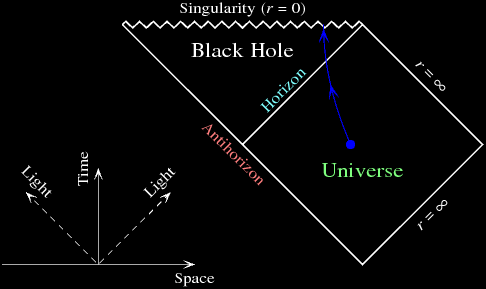
Scientists and astrophysicists are currently deeply engaged in exploring the imaginative capacities of their minds to unravel the mysteries of black holes. The singularity at the center of a black hole remains one of the most enigmatic phenomena in modern physics, with theories and hypotheses continuously being developed. One such theory, formulated by Roger Penrose, is represented in the diagram below. The Penrose diagram seeks to conceptualize the fabric of space-time in relation to a black hole. It addresses key questions: What occurs when an object crosses the event horizon? What lies within the horizon, where not even light can escape from, and which we are unable to observe through with the current technologies? At present, much of our understanding relies on the power of human imagination, and it is via this intellectual faculty that we may uncover a solution to the black hole puzzle in the near future.3

Image 1: Penrose Diagram of a Black hole.
Continue reading

Book Review: 12 Rules For Life, An Antidote to Chaos, by Jordan B. Peterson

First of all, in a way, this may sound as an odd comparison, but reading through this book, I found that Jordan Peterson’s writing style to bear a significant degree of resemblance to that of the renowned Russian author, Fyodor Dostoevsky. Both tend to employ a self-reflective, introspective dialogue in their works. However, unlike Dostoevsky’s often intricate and complex train of thought, Peterson’s approach is more direct and accessible, yet retains a similar depth of imagination.* A balance that I particularly appreciate. His 12 Rules for Life reads almost like a series of individual, self-contained mini-books, each of which could have been expanded further more in breadth if he had wanted. Peterson maintains a concise, focused narrative, ensuring that every sentence holds significance. In the final chapter, titled Coda, he skillfully ties together the preceding ideas, creating a structure that almost mirrors a well composed musical composition of the classics in my opinion.

Image 1: 12 Rules for Life by Jordan Peterson

It is particularly intriguing that Jordan Peterson simultaneously presents two seemingly contradictory worldviews on the subject of creation. On one hand, he references Darwinian principles, discussing how humans, like chimpanzees, are products of evolutionary processes. His extensive footnotes and bibliography, which include numerous works on research related to chimpanzees and other primates, clearly indicate his intent to draw distinct comparisons and analogies between human behavior and that of primates. This approach is particularly evident in his fifth chapter, where he discusses the importance of discipline and frequently references these studies to support his arguments. On the other hand, he advocates for the value of religious belief, particularly in God and Christianity, as beneficial, regardless of whether one perceives these beliefs as literal truths or metaphorical narratives. This juxtaposition raises compelling questions about the intersection of science and religion in understanding human existence. I appreciate this perspective, as the reality is that we do not yet fully know whether it is possible to dismiss religion as mere fiction or to regard science as a form of black magic. It is essential that we remain open to both possibilities, so as to avoid regretting a potential epiphany that our future selves might one day encounter. Frankly, I view Peterson’s ability to fully engage with two seemingly contradictory perspectives as a strong indicator of intellectual depth. By embracing both views with conviction and seeking to reconcile them within his own understanding, he demonstrates a commendable capacity for nuanced thought.

Continue reading

A Case For The Revival of Pure Forms in Architecture

Abstract: Through the discoveries made in astrophysics, it is safe to postulate that cosmic forces (gravity) exerted on mass prioritize on the long term establishment of equilibrium and purity. Our solar system is currently in its long term equilibrium phase, where planetary orbit takes place around the Sun and life flourishes on Earth. In Architecture, long term structural durability and aesthetic superiority may be achieved by implementing solids and voids that are designed with purity in mind. The geometric methods we may use for this deserves an entire separate paper or book on its own. The Roman architect Marcus Vitruvius Pollio has written extensively on these topics. However, in this essay, we will focus on the general argument for architectural purity. In times when liberated organic models of form dominate the avant-garde, it is appropriate and timely to present this alternative point of view.

The premise above will be disambiguated through worldly analogies, scientific observations and thought experiments presented in this paper.

An artistic illustration of Einstein’s theory of General Relativity, depicting a curved/bent fabric located in the space-time continuum under the influence of gravitational forces emitted by a perfectly spherical mass, causing long term orbital motion and equilibrium around stars and planets.

Continue reading