Tag Archives: science

Consciousness and Time

The fleeting nature of time serves as an adversary for nearly all living beings. In the wild, a grazing rabbit cannot linger too long without risking becoming prey. Similarly, a predator in the wild must act swiftly; hesitation allows its quarry to take sudden notice and escape. The passage of time establishes a natural sense of urgency in most living beings, forcing animals to be in a perpetual race to act quickly and efficiently for survival.* And, over the long term, time manifests a more sinister property of gradually pushing life into decay—bodies eventually weaken, and, unfortunately, life diminishes. In this context, one might assert that time inherently carries the essence of a silent adversary for all living beings over the long term. However, as human beings, somewhere along the line in the depths of our past, our hunter and gatherer ancestors have redefined their relationship with time by developing consciousness and the ability to contemplate on the future with the understanding of the nature of time. Through the development of our conscious faculties, we have somehow transformed time from a full adversary into a partial ally when needed. We are the only living beings on Earth capable of harnessing the passage of time to our advantage when we want to. Humans possess the unique ability to sit, reflect, and strategize, using time as a tool to solve problems. Our capacity for imagination and the willingness to learn through trial and error enabled us to approach challenges with patience and foresight, transforming the passage of time into a powerful resource for survival, growth, and advancement when needed.

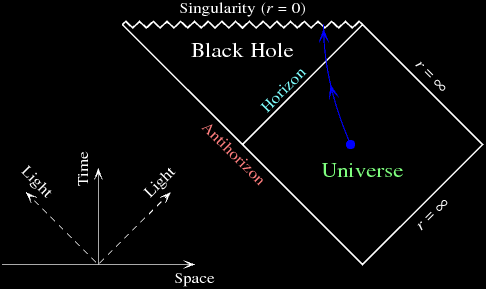
Image 1: Diego Velázquez, The Waterseller of Seville, 1618-22, oil on canvas, 105 x 80 cm (Apsley House, London, England)
Continue reading

Imagination: The Laboratory of Existence

Imagination is not separate from reality; rather, it is an integral part of it—a private reality that is intricately woven into the fabric of existence. Much like a laboratory, where experiments are conducted to uncover truths about the physical world, imagination is where we test and refine ideas, crafting them before they manifest in the external world. The thin bone barrier of the skull is all that separates this mental laboratory from our broader reality. And yet, what transpires within this private space frequently influences our external world, just as external experiences shape our imagination in return. Therefore, the degree of mastery we exhibit in navigating the physical world is intrinsically tied to our ability to command and cultivate our inner faculties—the private realm of thought and reflection.*

Consider the concept of black holes: their existence was not initially confirmed through the lens of a telescope but was instead conceived through the power of human imagination and the rigor of mathematical reasoning. The idea of a black hole emerged from the search for elegance and beauty within the mathematical equations of Einstein’s theory of general relativity. These celestial objects, with singularities at their core and event horizons at their external boundaries, remained purely theoretical until empirical evidence confirmed their reality. The inception of the concept took place in the imagination and its manifestation in space was later proven as technologies advanced. Similarly, Einstein’s theories of special and general relativity originated from intricate thought experiments long before their validation in the physical world.1 These examples underscore how imagination, especially when guided by reason and creativity, is a cornerstone of human progress and must therefore be recognized and nurtured as such in our largely obsolete educational systems.

“… this incredible fact that a discovery motivated by a search after the beautiful in mathematics should find its exact replica in Nature, persuades me to say that beauty is that to which the human mind responds at its deepest and most profound… “2

Scientists and astrophysicists are currently deeply engaged in exploring the imaginative capacities of their minds to unravel the mysteries of black holes. The singularity at the center of a black hole remains one of the most enigmatic phenomena in modern physics, with theories and hypotheses continuously being developed. One such theory, formulated by Roger Penrose, is represented in the diagram below. The Penrose diagram seeks to conceptualize the fabric of space-time in relation to a black hole. It addresses key questions: What occurs when an object crosses the event horizon? What lies within the horizon, where not even light can escape from, and which we are unable to observe through with the current technologies? At present, much of our understanding relies on the power of human imagination, and it is via this intellectual faculty that we may uncover a solution to the black hole puzzle in the near future.3

Image 1: Penrose Diagram of a Black hole.
Continue reading

Adapting to New Habits: A Lesson From Gravity

Gravity is the fundamental force that orchestrates the interaction of masses, drawing objects toward one another and providing the structural cohesion necessary for the universe. It governs the motion and balance of planets, stars, and galaxies, anchoring the cosmos in a delicate dance. Omnipresent and omnipotent on Earth, gravity extends across the universe with an ever-changing intensity that depends on position within the fabric of spacetime in relationship to planets, stars and other objects of non-negligible mass. As the unseen architect of motion and form, gravity shapes everything from the smallest particle in quantum mechanics to the largest celestial bodies in space such as Sagittarius A*, molding the universe and guiding the evolution of stars, galaxies, and life itself through time. Its influence reaches into every corner of existence, defining our physical world and the very essence of our reality.

F = (G * m1 * m2) / d^21

Image 1: The Pietà by Michelangelo (1498-1499) is an exemplary choice for this essay due to its masterfully detailed marble sculpting. The delicate yet powerful poses of the figures convey an overwhelming sense of weight and sorrow, allowing the viewer to almost physically feel the emotional gravity embedded within the composition.
Continue reading

On The Meaning of Failure: Insights from Planetary Evolution

For some obscure reason, most people are generally inclined to hesitate on taking decisive actions toward their envisioned and just goals, often paralyzed in decision-making by the fear of failure, self-doubt and most commonly, inner resistance1.

Failure is an inherent prerequisite for success, a principle evident not only in the evolutionary trajectories of living organisms but also in the history of celestial bodies. In our everyday language, it may be time to reconsider the term ‘failure’ and replace it with a more inclusive and constructive word, as what is often perceived as failure is, in fact, an integral step in the journey toward success. Even when a particular step does not immediately appear to contribute to the progress of success, it may later be recontextualized to serve a different purpose. Thus, one could argue that there is no true waste in, so-called, failure; it simply requires a deeper examination to uncover its potential in retrospect.

Let’s consider a broader perspective for a moment—one that includes the formation and evolution of planets in our solar system. In our planetary system’s early days, Mars and Mercury (yes, most likely, Mercury as well despite its smaller mass*) may have resembled Earth, with oceans, water, and perhaps even thriving life.2 However, due to its smaller size, these planets couldn’t sustain favorable conditions, eventually transforming into the red and gray, barren planets we know today. A mistake of nature?

Image 1: Image of Mercury taken by Nasa’s Messenger, and later colored in with respect to topographical and mineral composition data.

In contrast, Earth continues to support a vast ecosystem of life, demonstrating that, in some instances, success aligns with specific conditions and perseverance. Mars, though no longer able to harbor favorable conditions as Earth does, still holds significant value in respect to the future, reminding us that what may appear as a failure might yet serve a purpose in ways we cannot yet fully predict. Today, visionary thinkers like Elon Musk are exploring the possibility of revitalizing Mars, aiming to use it as a new frontier for life beyond Earth.

Continue reading