During the final moments of the Civil War, after corresponding via letters to discuss terms, General Robert E. Lee met with General Ulysses S. Grant at the Appomattox Court House on April 9, 1865, to formally surrender the Army of Northern Virginia to the Union’s Army of the Potomac. Lee, proud and emotional, arrived in full confederate gray military regalia, while Grant, not expecting the meeting so soon, was dressed in a more modest, shabby used uniform with mud stains on his boots. This contrast between the two leaders visually reflected the two very different characters of the generals. Grant was widely recognized for his modest demeanor and unassuming appearance, to the extent that many soldiers in his own ranks often had difficulty identifying him as the commanding lieutenant general, given his lack of formality and polished attire.1 Before their meeting at Appomattox, the two had briefly crossed paths years ago during the Mexican-American War (1846-1848). Grant, then a junior officer, remembered the esteemed General Lee and mentioned their past encounter, though Lee did not recall their earlier meeting.*
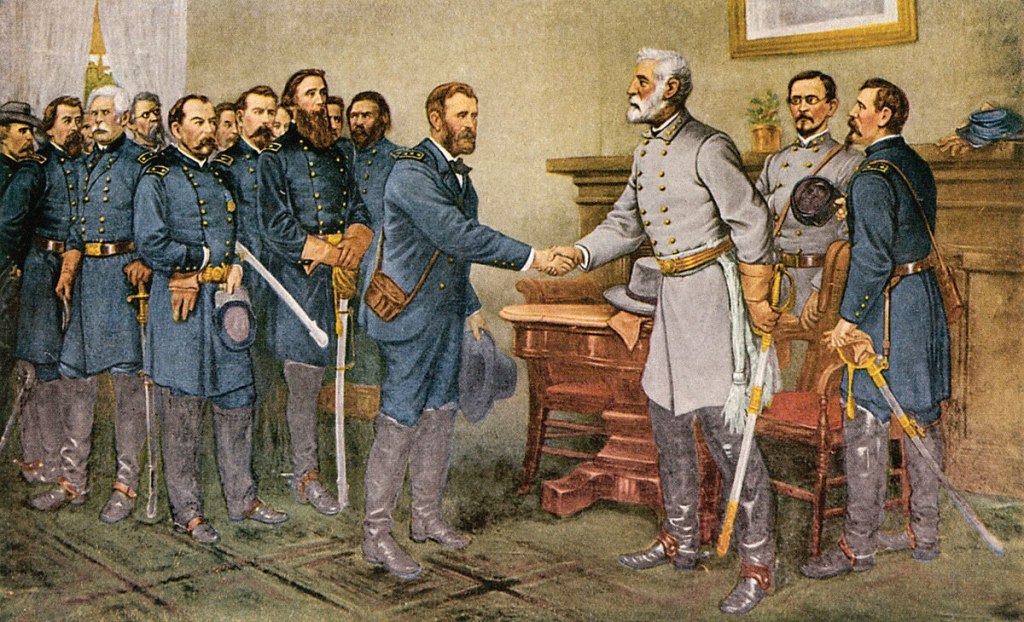
After an extended period of cordial conversation, during which Grant later reflected in his memoirs on how agreeable their exchange had been—so much so that he nearly lost sight of the meeting’s true purpose—General Lee eventually redirected the discussion to the matter at hand, inquiring about the terms of surrender. With characteristic magnanimity, shaped by the many hardships he had faced in his own career, Grant astonished Lee by offering unexpectedly generous terms for the Confederate surrender. Rather than imposing harsh punishments, Grant allowed the soldiers of the army of Northern Virginia to return home unhindered. They were provided with Union rations, allowed to keep their personal arms, and given safe passage back to their homes to resume their civilian lives. There were no trials, no confiscations, no immediate retributions—just a pathway back to peace.
Grant prudently understood that these soldiers would soon have to rejoin the Union and become ordinary citizens. A harsher approach by the Union victors could have severely undermined the prospects for long-term national reunification and hindered the reintegration of Confederate veterans into American society. Grant’s gesture stands in stark contrast to the punitive measures taken against Germany after the First World War, as outlined in the Treaty of Versailles. That treaty’s harsh terms, keeping German citizens in hardship and economic agony, helped create the conditions for Adolf Hitler’s rise to power, leading to yet another devastating global conflict, the second world war.
Grant’s empathy, while perhaps seen as a weakness by some—like Elon Musk3, who has spoken about empathy in those terms—can also be viewed as one of his greatest strengths, and his magnanimity during General Lee’s surrender laid the foundation for bridging the deep divisions between the North and South, fostering gradual reconciliation in the aftermath of the war. It helped the peaceful reconstruction and the long-term stability of the reunited United States.
* General Lee’s inability to recall their earlier encounter during the Mexican-American War, where they served the United States under one flag together, underscores the remarkable ascent of Grant’s prominence and success during the Civil War.
Footnotes:
1) For further reading on Grant’s life and military career, I strongly suggest reading the book: Grant, by Ron Chernow.
2) This quote has been taken from wikipedia.org’s description of the image at the following link: https://en.wikipedia.org/wiki/File:General_Robert_E._Lee_surrenders_at_Appomattox_Court_House_1865.jpg
3) For reference, please read my essay: “Elon Musk’s Unconventional Strategy: A Game-Like Approach to Business”. https://sahinarikoglu.com/2024/02/01/elon-musks-unconventional-strategy-a-game-like-approach-to-business/
Image Credits:
Image 1: Courtesy of Granger Historical Picture Archive, http://www.granger.com


