Category Archives: Architecture and Urban Design

A Proposal On The Revitalization of Gardening and Parks

The thesis of this essay is on why we should revitalize and prioritize parks, parkways, park systems and the activity of gardening in the planning of new towns or cities, urban or suburban. This can only be achieved through the implementation and enforcement of proper urban planning policies with the underlying goal of progress in civility and societal refinement in mind. Below is a detailed argument in support of this premise.

When one embarks on a long term journey of personal fitness, periodically lifting weights at the gym or running in an outdoor environment with discipline, many other aspects of his life starts to get indirectly effected. He is more likely to eat clean, stand up straight with a good posture, better maintain his personal appearance and hygiene, be more sociable and confident, be more healthy in the eyes of his doctors, sleep better and be more sociable during the day. Thus, it may be said that routine exercise is a pivotal activity which positively influences other facets in our lives. And, so is gardening not just about finding the energy to water long forgotten plants in our balconies, but if practiced with discipline and in the right setting, also a pivotal activity which paves the way towards developing many other important human virtues.

Continue reading
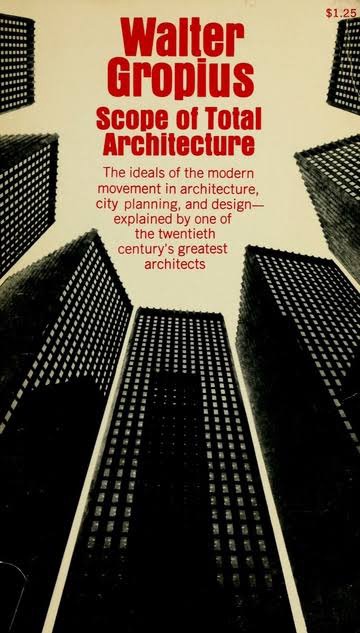
Book Review: Scope of Total Architecture. By Walter Gropius, 1955

Scope of Total Architecture

With its pragmatic architectural curriculum, as I was studying at the University of Maryland’s Architecture and Urban Design program (2006-2011), I have first heard about Walter Gropius and the Bauhaus movement from my mentors. Skimming through various picture books of Bauhaus products and buildings in the schools library, I ruled out using such precedents for my design projects due to its emphasis on the repetitive international/global style which I assumed it prioritized. However, as I read this book written by Gropius himself, to my surprise, my initial negative thoughts on the theoretical side of the Bauhaus formed during my studies were one by one proven wrong. It turns out that, Mr. Gropius, is in fact a region sensitive architect and writer who tends to be against an overarching omnipresent international style, and is, actually, quite displeased that his work had been interpreted by others as a international “style” in design.

After the Great war he took on to the daunting task of establishing the Bauhaus institution to engage context and circumstance appropriate meaning to the technological innovations in his field. His main aim being to utilize the apparently cold new industrial building technologies to serve a more humanist agenda through collaborative theoretical and craft/skill oriented design processes.

Continue reading

On the Cilician Block

Pope Sixtus The Fifth

The proper question to ask would not be on how to quickly amend the disorganization and the level of common sense deviations confronting the city. That would not be possible. There would be no quick fix to the three-dimensional urban manifestations of such short term flawed thinking.  In the case of Rome, where the city was also confronted with a disorganized ununified city fabric, the visionary with power at the time, Pope Sixtus the Fifth, had set in motion a long term generational urban effort by the architects/artists and engineers of Rome to bring about a successful urban composition that has been proudly preserved as of today.

Continue reading

A Case For The Revival of Pure Forms in Architecture

Abstract: Through the discoveries made in astrophysics, it is safe to postulate that cosmic forces (gravity) exerted on mass prioritize on the long term establishment of equilibrium and purity. Our solar system is currently in its long term equilibrium phase, where planetary orbit takes place around the Sun and life flourishes on Earth. In Architecture, long term structural durability and aesthetic superiority may be achieved by implementing solids and voids that are designed with purity in mind. The geometric methods we may use for this deserves an entire separate paper or book on its own. The Roman architect Marcus Vitruvius Pollio has written extensively on these topics. However, in this essay, we will focus on the general argument for architectural purity. In times when liberated organic models of form dominate the avant-garde, it is appropriate and timely to present this alternative point of view.

The premise above will be disambiguated through worldly analogies, scientific observations and thought experiments presented in this paper.

An artistic illustration of Einstein’s theory of General Relativity, depicting a curved/bent fabric located in the space-time continuum under the influence of gravitational forces emitted by a perfectly spherical mass, causing long term orbital motion and equilibrium around stars and planets.

Continue reading

God Is In The Budget


house1

Low budget projects are mostly a waste of time. No matter what intellectual effort you put chances are pretty high that the product is going to look bad up close in detail, specially for projects in the East. In these types of buildings your enthusiasm will not be acknowledged and shared by the cheap workmanship and cheap construction materials used on the building. Everyone is going to be there on site to get the job done quickly with as little effort as possible and then get out. The massing and site diagram of the project could be flawless, but detailing of the structure will be a mess no matter how often you visit the construction site. Modules will be executed optionally, causing a disastrous chain reaction of aesthetic catastrophes, railings and other building components such as window sills will not be in harmony regarding color palates and material properties. All construction materials will be selected by the subcontractor based on price, not on compositional compatibility. Architecture does not have immunity from the bitter toughness of capitalism, just like any other profession except for music and the visual arts such as painting and sculpting. A good musician can sit down with sticks and stones or a broken guitar and produce acceptable art work, but in the highly collaborative profession of architecture its different; budget really does make a huge difference. Continue reading

In Defense of Classicism

The more I think of it, the more I believe that Marcel Duchamp’s “fountain” is a disgrace to the art world.

If he had not put that urinal in display arguing that any stupid thing could replace excellency in craft, we wouldn’t have had todays shallow pop culture. He enticed hoards of untalented wanna be artists into the world of art. Degrading humanity all together. Continue reading

Are All Cities Ready For Architecture?

An architect can try to do all his best, but if the culture is unwilling to accept the value of buildings he is just wasting his time.

Not only is an architect challenged while designing and implementing artistic common sense during interdisciplinary collaboration, but what he gets built after the design process is also heavily vulnerable to constant civic sabotage and his intellectual intent to constant vandalization. Continue reading

The Truth About Big Cities

new-york-city_0

A city is an unnatural habitat for human beings and is no different than a cancer tissue on Earth, which grows and grows until it destroys its host by turning natural wildernesses into concrete and steel jungles.

Similar to how our digestive systems are not yet evolved and adopted to agricultural inventions such as bread and rice (Which is clearly the case when the levels of insulin and sugar in our blood streams are analyzed after consuming these products), living cramped with more than two million people in a 800km2 area is also a social invention which both our psychological and physiological systems are not adopted to. And looking at the slow rate of evolution through out the history of men, it is highly unlikely that we will ever adopt to big cities in the next few millennia.  Continue reading