Tag Archives: history

Exploring the Possibility of Telepathic Communication

“… The ether is a great cosmic mass of eternal forces of vibration. It is made up of both destructive vibrations and constructive vibrations. It carries, at all times, vibrations of fear, poverty, disease, failure, misery; and vibrations of prosperity, health, success, and happiness, just as surely as it carries the sound of hundreds of orchestrations of music, and hundreds of human voices, all of which maintain their own individuality, and means of identification, through the medium of radio. …”

Think and Grow Rich, Napoleon Hill pg.44

Guglielmo Marconi with an early version of his radio invention, photo taken around 1890

When first proposed the idea of transmitting messages through invisible radio waves, Guglielmo Marconi’s contemporaries dismissed him as delusional. Unable to imagine that voices and signals could travel through the air without wires, some even went so far as to place him under psychiatric supervision. Yet Marconi persevered, conducting experiments on rooftops and across open fields, gradually proving that his invention could span great distances. His breakthroughs not only revolutionized communication but also laid the groundwork for innovations that would reshape warfare, commerce, and everyday life. Today, radio communication is a cornerstone of modern life, from emergency services to global broadcasting, from navigation systems to the invisible networks that connect our smartphones1. The discovery and use of radio waves stands as a powerful reminder that what once seemed like fantasy can, through vision and persistence, become foundational technology—and that progress often begins at the edge of disbelief.

This paper’s premise: could telepathy—communication with others through the power of thought—be another frontier awaiting discovery? A mystery embedded within the ether, not transmitted through radio devices, but instead through our minds?

Continue reading

The Necessity of Subordinating Emotions in Decision-Making: Alexander Hamilton’s Fall

Amidst battling a cold and feeling physically drained, Commander-in-Chief John Adams, driven by a sense of duty, traveled from his hometown of Quincy to Trenton in 1799. There, he convened with his cabinet to deliberate on strategic options in the event of possible war with France.* At the time, American maritime trade was under constant threat from French warships at the Atlantic, provoked by the administration’s favorable stance toward Britain, a rival of revolutionary France. Adams believed in Peace Through Strength, thus he was interested in establishing a strong navy as a deterrent and a tool for leverage in future negotiations with France.

Previously, Adams’ envoys faced a degree of humiliation at the hands of the French Directory, where they were largely dismissed and treated as subordinates. However, with Napoleon Bonaparte’s ascension to power, the dynamics shifted, offering renewed hope for a better relationship between the U.S. and France.

The newly established United States faced the delicate challenge of navigating alliances among the dominant European powers. Alexander Hamilton and the Federalists favored policies that aligned with Britain, while Republicans, led by Thomas Jefferson, sought closer ties with revolutionary France. John Adams, burdened with the responsibility of his office, despite being aligned with the Federalist camp, displayed political mastery by treading carefully between these two competing interests, ensuring a balanced approach for the young nation with a focus in developing industries and the navy.1

Image 1: Alexander Hamilton by John Trumbull 1805

Alexander Hamilton, a prominent Federalist renowned for his eloquence and energy, fervently advocated for war with France, perceiving President Adams’ reluctance as a direct challenge to his Federalist principles. Convinced that a war was necessary, Hamilton had previously persuaded George Washington to support the formation of a resource consuming standing army, with Hamilton himself appointed as its commander. At the time, Hamilton’s ambition was well-known, and it was rumored that he suffered from a type of “Napoleon complex,” a notion reinforced by Abigail Adams, who mockingly referred to him as “Hamilton Bonaparte.” in one of her letters.2

Continue reading

The Gulag Archipelago: Inner Radar

The Gulag Archipelago1 offers a personal and introspective account of the soviet gulag system as Solzhenitsyn reflects not only on his own experiences but also on the broader ideological framework that underpinned Stalin’s Soviet regime. In his book, he describes the systemic cruelty of the soviet prison systems (Gulags), examining the role of the “blue caps” — the Soviet officers who administered the brutal labor camps and interrogated prisoners at their headquorters2 — and the broader philosophy (or lack of a real philosophy?) that shaped their actions. He points out how the corrupt nature of a social system can tempt even honorable individuals to conform to it, bringing out their worst sides. And if not succumbed to the system, then unmercifully exiled or, in most cases, imprisoned. He argues that when a corrupt idealism and philosophy drive evil acts, people are often drawn further into darkness. Solzhenitsyn’s work probes into the dehumanizing effects of this system, illuminating both its individual and collective dimensions. According to him, one of the primary factors enabling such pervasive evil by the blue caps was the level of compliance of ordinary Russian citizens, who, without any resistance, passively obeyed, leading to their eventual interrogation and transfer to the Gulags on a massive scale.*

One theme that particularly resonated with me was his discussion of the “inner radar.” Through his interactions with new prisoners and observations of camp dynamics, Solzhenitsyn describes a nearly instinctual ability to identify possible informants and those with possible malicious intents by analyzing certain visual cues and body language, an intuition he learned to trust through time, as this skill was crucial for navigating such an environment.

Image 1: Book cover of The Gulag Archipelago by Alexandr Solzhenitsyn
Continue reading

Empathy in Leadership: Grant and Lee’s Historic Meeting at Appomattox

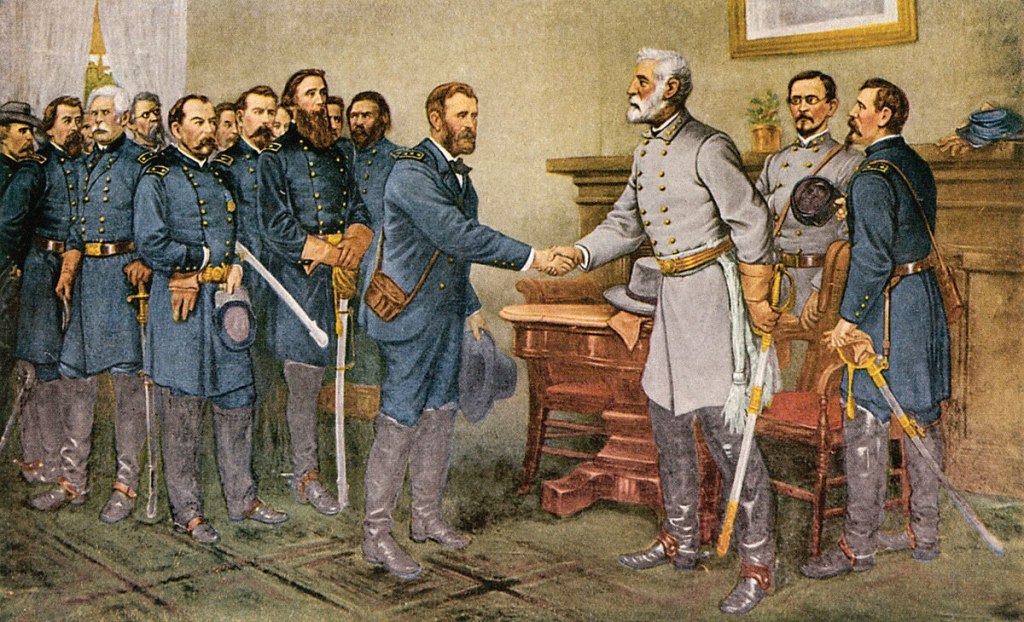
During the final moments of the Civil War, after corresponding via letters to discuss terms, General Robert E. Lee met with General Ulysses S. Grant at the Appomattox Court House on April 9, 1865, to formally surrender the Army of Northern Virginia to the Union’s Army of the Potomac. Lee, proud and emotional, arrived in full confederate gray military regalia, while Grant, not expecting the meeting so soon, was dressed in a more modest, shabby used uniform with mud stains on his boots. This contrast between the two leaders visually reflected the two very different characters of the generals. Grant was widely recognized for his modest demeanor and unassuming appearance, to the extent that many soldiers in his own ranks often had difficulty identifying him as the commanding lieutenant general, given his lack of formality and polished attire.1 Before their meeting at Appomattox, the two had briefly crossed paths years ago during the Mexican-American War (1846-1848). Grant, then a junior officer, remembered the esteemed General Lee and mentioned their past encounter, though Lee did not recall their earlier meeting.*

Image 1: “Lee’s surrender 1865. ‘Peace in Union.’ The surrender of General Lee to General Grant at Appomattox Court House, Virginia, 9 April 1865. Reproduction of a painting by Thomas Nast, which was completed thirty years after the surrender.”2

After an extended period of cordial conversation, during which Grant later reflected in his memoirs on how agreeable their exchange had been—so much so that he nearly lost sight of the meeting’s true purpose—General Lee eventually redirected the discussion to the matter at hand, inquiring about the terms of surrender. With characteristic magnanimity, shaped by the many hardships he had faced in his own career, Grant astonished Lee by offering unexpectedly generous terms for the Confederate surrender. Rather than imposing harsh punishments, Grant allowed the soldiers of the army of Northern Virginia to return home unhindered. They were provided with Union rations, allowed to keep their personal arms, and given safe passage back to their homes to resume their civilian lives. There were no trials, no confiscations, no immediate retributions—just a pathway back to peace.

Continue reading

Integration of Building and Landscape: Frederick Law Olmsted’s Approach

Grounds of the US Capitol, by Frederick Law Olmsted 18741

Successfully designing a formal, pastoral, scenic, or sublime landscape involves a complex synthesis of artistic vision and horticultural expertise. A landscape architect must possess an in-depth knowledge of tree and plant species suited to specific climates and regions, as well as advanced skills in composition making and spatial arrangement. Achieving mastery in this field requires extensive research, hands-on experience, and a deep, inquisitive intellect. Only through rigorous study, practical application, and innate creativity can one effectively conceptualize and realize a harmonious and aesthetically compelling landscape in the likes of what Frederick Law Olmsted and Andrew Jackson Downing accomplished.

The already intricate task of balancing the inherent chaos of nature with structured order is further complicated when the necessity of integrating a man-made structure, a building, into the landscape is required.2 This building, a completely man-made intervention on the site, must not only harmonize with its natural surroundings but also stand out as a focal point within its immediate context. The challenge here lies in ensuring that the landscape design both complements and enhances the hierarchical order, with the building at the most prominent point. To achieve this, effective collaboration is essential. Individual egos must be set aside in favor of teamwork and a collective commitment to the overarching vision.

Continue reading

A Proposal On The Revitalization of Gardening and Parks

The thesis of this essay is on why we should revitalize and prioritize parks, parkways, park systems and the activity of gardening in the planning of new towns or cities, urban or suburban. This can only be achieved through the implementation and enforcement of proper urban planning policies with the underlying goal of progress in civility and societal refinement in mind. Below is a detailed argument in support of this premise.

When one embarks on a long term journey of personal fitness, periodically lifting weights at the gym or running in an outdoor environment with discipline, many other aspects of his life starts to get indirectly effected. He is more likely to eat clean, stand up straight with a good posture, better maintain his personal appearance and hygiene, be more sociable and confident, be more healthy in the eyes of his doctors, sleep better and be more sociable during the day. Thus, it may be said that routine exercise is a pivotal activity which positively influences other facets in our lives. And, so is gardening not just about finding the energy to water long forgotten plants in our balconies, but if practiced with discipline and in the right setting, also a pivotal activity which paves the way towards developing many other important human virtues.

Continue reading

A Case For The Revival of Pure Forms in Architecture

Abstract: Through the discoveries made in astrophysics, it is safe to postulate that cosmic forces (gravity) exerted on mass prioritize on the long term establishment of equilibrium and purity. Our solar system is currently in its long term equilibrium phase, where planetary orbit takes place around the Sun and life flourishes on Earth. In Architecture, long term structural durability and aesthetic superiority may be achieved by implementing solids and voids that are designed with purity in mind. The geometric methods we may use for this deserves an entire separate paper or book on its own. The Roman architect Marcus Vitruvius Pollio has written extensively on these topics. However, in this essay, we will focus on the general argument for architectural purity. In times when liberated organic models of form dominate the avant-garde, it is appropriate and timely to present this alternative point of view.

The premise above will be disambiguated through worldly analogies, scientific observations and thought experiments presented in this paper.

An artistic illustration of Einstein’s theory of General Relativity, depicting a curved/bent fabric located in the space-time continuum under the influence of gravitational forces emitted by a perfectly spherical mass, causing long term orbital motion and equilibrium around stars and planets.

Continue reading