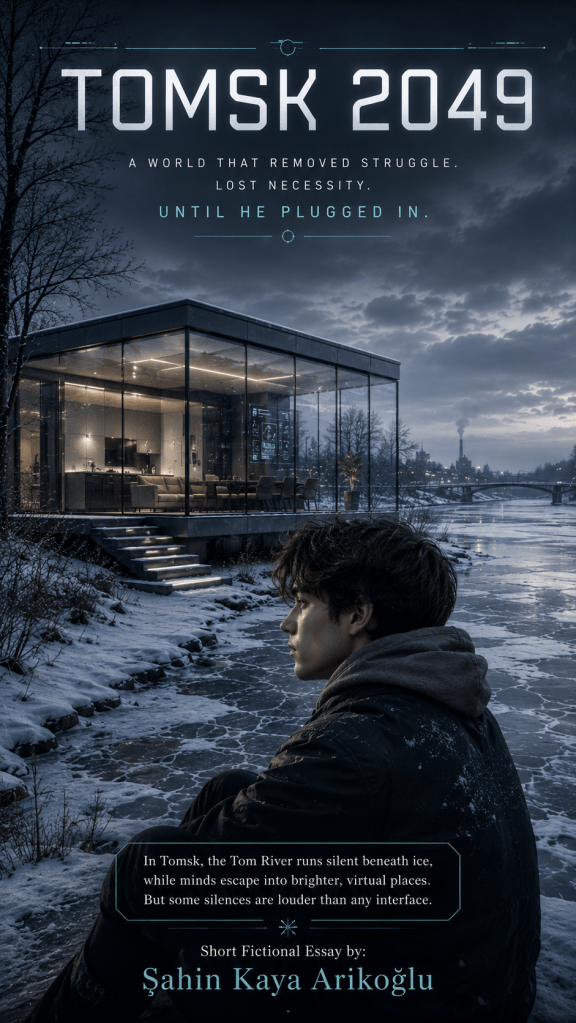
It was a rough February afternoon in Tomsk. The temperature had fallen below minus twenty Celsius, and the surface of the Tom River had frozen into a dull sheet of white steel stretching beneath the pale Siberian sky. No one gathered there anymore. The old winter-swimming festivals — once celebrated with music, vodka, bonfires, and Orthodox blessings — had quietly disappeared over the years, another tradition dissolved by comfort, bureaucracy, and apathy.
Arseny had not left his house in one hundred and twenty-four days.
He drifted awake slowly inside his orthopedic sleep capsule, suspended somewhere between consciousness and dream. For nearly four years he had suffered from the same recurring nightmare: falling. Sometimes he was trapped inside a descending aircraft, sometimes slipping from the upper floors of a tower, but the sensation was always identical — a helpless downward pull accompanied by overwhelming dread. On certain mornings the feeling lingered long after waking, clinging to him for hours through out the day.
Assuming it might somewhat ease the lingering effects of his dreams, he wanted to repair his sleep schedule before traveling with his mother, Alexandra, who had recently finalized her third divorce. She had convinced him to accompany her to a coastal resort near Latakia, in the Russian-administered protectorate along western Syria — one of the few mediterranean warm-water regions still heavily frequented by Russian tourists after the Mediterranean migration crises of the 2030s.
From across the room he squinted at the illuminated clock.
04:53.
He could no longer tell whether it was morning or afternoon. In Tomsk’s winter light, time itself had become abstract. Similar to the antarctic’s, days blended together into one continuous gray atmosphere. The numbers on the clock felt decorative rather than meaningful.
Like most people his age, Arseny had been medicated since childhood.
After suicide rates surged throughout the 2030s, the Russian government passed the Mental Stability Act, requiring weekly psychiatric evaluations for all citizens above the age of eight. Most consultations occurred remotely through neural-video sessions. Human psychiatrists had become rare; the overwhelming majority were diagnostic AIs trained to detect psychological irregularities through speech cadence, facial micro-expressions, pupil dilation, and biometric fluctuations. The system was considered efficient. Whether it actually healed anyone remained questionable.
Russia had culturally preserved itself better than much of Europe. Its borders remained harshly controlled, immigration heavily restricted, and its state identity unusually intact for the modern world. Yet despite political resistance to globalization, cultural homogenization seeped through digital networks anyway. By the late 2040s, entire generations across continents dressed alike, spoke alike, consumed identical entertainment, and increasingly shared the same emotional emptiness.
Outside his bedroom window Arseny watched the afternoon drone lanes moving through the sky — thousands of autonomous delivery units gliding silently above the frozen river in organized streams. The horizon looked less like nature and more like a motherboard.
His glass house stood directly along the Tom River: a sleek prefabricated structure composed of aluminum framing, adaptive smart glass, and self-regulating environmental systems. Entire neighborhoods like this could now be assembled by construction robots within forty-eight hours. Traditional architecture had largely vanished from middle-class life decades earlier. Buildings were no longer designed individually; they were planned by AI, manufactured, optimized, and deployed.
There were still famous architects, of course, but only a handful — global celebrities commissioned by governments, sovereign corporations, and the ultra-wealthy. Regional identity in architecture had mostly disappeared. Cities across the world increasingly resembled one another: clean, efficient, sustainable, and spiritually interchangeable.
The house handled everything automatically.
Energy, water purification, food delivery, climate regulation, medical monitoring — all seamlessly integrated into the structure itself. The smart glass concealed the interior completely when needed while preserving a perfect outward view. Arseny never worried about bills, repairs, or even groceries. Anything he desired could arrive within minutes via highly efficient drone transport.
The system removed friction from life. It had also removed necessity. He no longer needed to struggle, negotiate, think ahead, or socialize. Every discomfort had been engineered out of existence. Sometimes he wondered whether modern people were still citizens at all, or merely well-maintained zoo animals.
As he shifted upright in bed, he suddenly recoiled.
A burning hand rested against his back.
He turned.
Beside him lay a woman in her early twenties — blonde hair scattered across the pillow, pale skin illuminated by the soft ambient lighting of the room. Her proportions were almost unnervingly symmetrical and beautiful, as if calculated rather than inherited. Green-hazel eyes, delicate facial geometry, long legs, a narrow waist. Beautiful in a way that almost felt unreal.
Her name was Siri.
Five years earlier, Apple Biotics had released the first commercially successful emotional-companion cyborgs after global birth rates collapsed to historic lows. What began decades earlier as a primitive phone assistant had evolved into a synthetic partner nearly indistinguishable from a human being in casual interaction.
At least initially.
“Good afternoon, sweetie,” Siri said softly in Russian.
There was the faintest delay behind her smile.
Arseny kissed her before standing. Her eyes attempted to follow him seductively, though their focus drifted slightly off-center for a fraction of a second — a widely criticized defect introduced after the latest firmware update. Millions of users had reported similar issues worldwide.
Last month’s update had also introduced thermal-emulation routines designed to mimic human body warmth during sleep. Unfortunately, overheating incidents had already triggered several lawsuits across North America and East Asia.
To big to fail, Apple’s market value barely moved.
The corporation had become economically larger than many sovereign states. After acquiring several collapsing Mediterranean islands from Greece during the debt restructurings of the 2030s, Apple-administered territories now operated under semi-autonomous legal agreements. Full-time employees even carried corporate travel passports recognized by dozens of nations.
Arseny entered the kitchen and opened the medicine cabinet.
Five pills.
Without them, he could barely function.
Several times he had attempted to quit abruptly, but withdrawal crushed him within hours — panic, tremors, emotional collapse. The medication no longer made him happy; it merely returned him to baseline normality.
That was the strange thing about Siri. Technologically, she was extraordinary. Biologically, something still felt absent. No matter how sophisticated the software became, some deeper part of his mind recognized the illusion. Human beings had evolved over hundreds of thousands of years within tribes, landscapes, rituals, seasons, touch, competition, friendship, danger. His nervous system still expected real eye contact, physical organic presence, genuine laughter, and from time to time even unpredictability.
Instead it received algorithms designed by AI.
The body could not fully metabolize synthetic intimacy. And beneath all the comfort, his organism knew it.
On the kitchen table rested a polished silver neural chip no larger than a coin. Arseny lifted it and attached it carefully to the base of his neck.
“Password: Arseny4938.”
Immediately his body froze.
His eyes remained open, but vacant.
The room dissolved.
There were no laptops anymore. No phones. No visible screens. The neural interface connected directly into cortical pathways, allowing the internet to merge partially with conscious perception itself. Thought and network had become intertwined.
His body sat motionless in Siberia.
But his mind was already somewhere else.
To be continued…

